Announcement
Virtual GI Solutions Deliver Substantial Cost Savings While Improving Symptoms for Patients






NEW YORK —
The Peterson Health Technology Institute (PHTI) today released a new evaluation finding that virtual gastrointestinal (GI) solutions can improve symptoms while lowering total costs. These solutions improve symptoms and quality of life for patients with irritable bowel syndrome (IBS), and those that integrate gastroenterologists can also improve clinical outcomes for inflammatory bowel disease (IBD). All solutions can help lower net healthcare spending by reducing avoidable hospitalizations and other high-cost healthcare services.
GI conditions affect one in five U.S. adults and account for an estimated $112 billion in annual healthcare spending, yet access to coordinated gastroenterology care remains limited. IBS and IBD cause chronic symptoms that negatively impact patients’ physical health, mental health, quality of life, and productivity. Despite affecting so many Americans, these conditions often go undiagnosed or undertreated, with many patients facing months-long diagnostic processes and fragmented care. Gastroenterology has the third-longest wait times of any specialty, and multidisciplinary GI programs are largely limited to academic medical centers, leaving many regions with limited access to coordinated GI care.
“The clinical improvements from virtual GI solutions are meaningful for patients managing these chronic conditions that disrupt daily life,” said Caroline Pearson, Executive Director of PHTI. “These solutions can also produce valuable cost savings by improving symptom management and avoiding flare-ups that often lead to emergency department visits, testing, and hospitalizations.”
PHTI evaluated five virtual GI solutions: Ayble Health, Cylinder Health, Digbi Health, Oshi Health, and Salvo Health. While these solutions are designed to address a wide range of GI conditions, this assessment focuses on outcomes for IBS and IBD, which are the most common and costliest GI conditions, respectively. For this report, PHTI reviewed more than 1,700 articles and other evidence, including information submitted by companies with solutions included in the report.
The assessment examined two distinct categories of virtual GI solutions:
- Wraparound solutions that complement patients’ existing GI care with nutrition counseling, gut-brain behavioral health support, and symptom tracking. For patients with IBS, wraparound solutions deliver clinically meaningful improvements in symptoms and quality of life. However, there is no evidence that wraparound solutions deliver clinical benefits for people with IBD compared with usual care. These solutions also substantially decrease net healthcare spending by approximately $1,900 per year for each patient with IBS that uses the solution in the commercial market.
- Clinician-led solutions integrate gastroenterologists with other clinicians and support services to deliver virtual multidisciplinary care. For patients with IBD, virtual multidisciplinary care can deliver outcomes comparable to in-person specialty care. Similar to wraparound solutions, these companies also offer support services that improve symptoms and quality of life for patients with IBS. Despite having a higher price than wraparound solutions, clinician-led solutions lower net healthcare spending for patients with both IBS and IBD. They are especially economically beneficial when targeted to patients with moderate-to-severe IBD, as well as patients with IBS—saving an estimated $2,900 per patient per year.
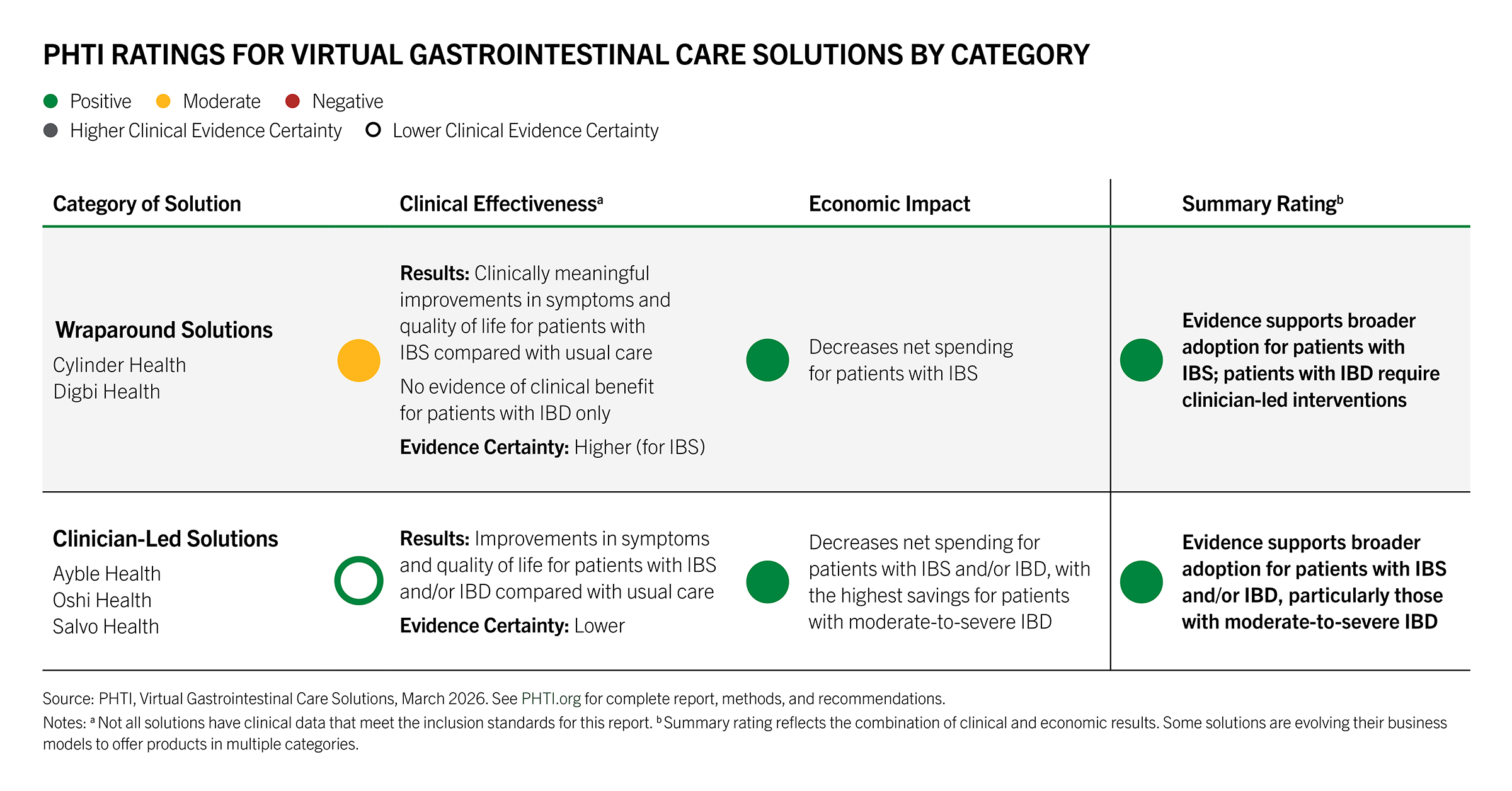
While the findings support broader adoption of virtual GI care, additional evidence is needed to assess long-term durability of outcomes, effectiveness across diverse populations, and optimal pricing and contracting models. The report calls for more focused deployment of virtual GI solutions, stronger evidence generation, and better-aligned payment models to realize substantial economic and patient benefits.
PHTI’s evaluation is based on its independent assessment framework, which evaluates the clinical and economic impact of digital health solutions. The report was developed in collaboration with clinical advisors and experts in gastroenterology, health economics, and health technology assessment. PHTI also conducted interviews with patients with GI conditions who had experience using the assessed virtual solutions.
###
About the Peterson Health Technology Institute
The Peterson Health Technology Institute (PHTI) provides independent evaluations of innovative healthcare technologies to improve health and lower costs. Through its rigorous, evidence-based research, PHTI analyzes the clinical benefits and economic impact of digital health solutions. These evaluations inform decisions for providers, patients, payers, and investors, accelerating the adoption of high-value technology in healthcare. PHTI was founded in 2023 by the Peterson Center on Healthcare. For more information, please visit PHTI.org